Showing posts with label astrogeomancy. Show all posts

Tuesday, 27 June 2023


THE ELEMENTS OF ASTROGEOMANCY (I)

Towards a Recreation of the Megalithic Spiritual Science 

© Xavier de la Huerga 2023


Context – The Primordial Continuum of Knowledge and the Unified Perception Mode

As it has been explained somewhere else in this blog, astrogeomancy attempts the reintegration of the elements making up the continuum of knowledge that was applied millennia ago by high megalithic cultures as the result of a unified perception mode; very different from the current perception mode of human beings. This primordial continuum of knowledge can only be understood today by our modern minds as a synthesis of several related but distinct scientific disciplines with aesthetic and spiritual dimensions integrated. However, it was in fact originally apprehended as a multi-faceted seamless whole, going beyond what we today call science, art and spirituality. Following the clues an solid proofs left behind by our ancestors - their monuments, mainly -, astrogeomancy attempts to recreate the unified perception mode behind this primordial continuum of knowledge through reverse engineering, studying and implementing simultaneously all those aspects we perceive today as separate fields.

The revolutionary discoveries of psychiatrist, neurophysiologist, historian and philosopher Iain McGilchrist on the roles of the two brain hemispheres, lends support to the existence of a "unified perception mode" amongst megalithic builders.

It is important to fix the mind's eye steadfastly onto the concept of a primordial continuum of knowledge not just as a synthesis of different elements blended together, but as a pre-existent whole without any fissures, that however displays a number of different facets or qualities pertaining to the greater body; a gestalt that not only transcends the sum of its parts, but antecedes it. During millennia, awareness of this continuum has been disintegrating, losing its original cohesion and breaking apart due to the loss of the unified perception mode among humans. 

The above realisation will help us to better understand the relationships, correspondences, connections and reciprocities - frequently acausal - between what the modern mind only perceives as a cluster of fortuitous coincidences and disconnected data, present throughout many of the enigmatic megalithic designs.

The Quadrivium

In the western world the megalithic primordial continuum of knowledge survived into history in a fragmented and diminished form through the Pythagorean schools and Plato's Academy. It eventually surfaced at the start of the Middle Ages by the hand and quill pen of Abbot Cassiodorus with the name of Quadrivium. From his codification of the ancient teachings into various encyclopedic compilations (Instituciones), the Quadrivium was established as the core curriculum for European universities until the XIV century.

This curriculum was centred around the Seven Liberating Arts, so called because they were  considered essential for the inner cultivation of free-thinking human beings. Of these seven arts, the Quadrivium constituted the advanced stage, consisting of arithmetic, geometry, astronomy and harmony - nowadays known as music theory or musicology.

Wrongly translated as "four ways", the precise meaning of Quadrivium is "quadruple way", or "place where four ways meet", which points back in time to the underlying unity found in the vision and methodology of the high megalithic cultures. Therefore, the Quadrivium was taught as a whole, implying that it was not possible to achieve a proper, deep comprehension of any of the four arts in isolation from the other three. Their simultaneous implementation on megalithic constructions exemplifies in the practice hundreds of cases in which these four disciplines weave themselves into a coherent whole.


A woman teaching geometry during the Middle Ages

The four arts/sciences that make up the Quadrivium are a very convenient starting point to elucidate the elements of astrogeomancy, even though many megalithic monuments encompass other disciplines such as metrology and geodesy and occasionally include a mysterious component that it is not easily explainable. We will have a look at those additional elements in the second part of this article.

One must be aware that we are not dealing here with the modern, conventional, utilitarian versions of these four disciplines, but with their ancient forms through which it is sought their capacity to trigger the spiritual revelatory experience, and with this transcendent approach, the holistic understanding of them all. As Plato tells us towards the end of Book VII of The Republic; “...when all these studies reach the point of inter-communion and connection with one another, and come to be considered in their mutual affinities, then, will the pursuit of them have a value for our objectives; otherwise there is no profit in them”. 

Be it as repository of prehistoric lore through the Pythagorean oral tradition, via his Egyptian contacts, or else as an original rediscoverer of a fragment of the prisca sapientia; Plato knew that it was vital for the education of healthy human beings to reassemble these four pieces of the scattered cosmic puzzle.

Each of the arts/sciences of the Quadrivium was portrayed as a female. Perhaps a memory of origins in the distant past?

The Four Convergent Sacred Arts

Arithmetic.  Beyond calculus and the purely quantitative functions of number, there are its qualitative characteristics, the dynamics of interrelations and proportions, the regularity and harmony of ratios. Sacred arithmetic investigates number in its abstract purity, its symbolic dimension leads us to a deep understanding of reality, of the form or archetype of the good. As Plato expounds in The Republic; “...until they see the nature of numbers with the mind only; not like merchants or retail-traders, with a view to buying or selling... but for the sake of the soul herself; and because this will be the easiest way for her to pass from becoming to Truth and Being." The Pythagorean axiom; "all is number" illustrates the realisation that the deepest substrate of reality and the language through which nature becomes intelligible is number.

Geometry. Again through Plato's dialogues and also Pythagoras' teachings, is emphasised the capacity of geometry to take us to the ultimate truth, beauty and goodness, beyond its utilitarian and mundane applications. The description of geometry as "the art of the ever-true", defines this eminently spiritual perspective, which is also known nowadays as sacred geometry. In the context of megalithic culture, geometry takes on its true etymological meaning, since it is applied to measuring the earth and to define the placement and orientation of monuments at a geodetic scale. Thus we can rightly define geometry as "number in space"

Astronomy. In antiquity until the Middle Ages, astronomy was identical with astrology, in an age when the prevalent and very universal paradigm was animism and the universe was alive, possessed intelligence and was filled with purpose. In the animist cosmovision, the heavens are populated with archetypes embodied in the planetary and stellar orbs, cosmic forces - goddesses, gods, titans - interact with human beings and through their movements generate cycles, calendrical computations, sacred festivals and the arrangement of society around them. The rising and setting of celestial bodies produce alignments to topographic features, providing the geometric and angular parameters for the orientation of settlements and temples that spring up as a reflection of heaven on earth. The role of sunlight is sacred; physical sunlight being a consequence and manifestation of divine light. It is fitting to define sacred astronomy as "number in movement, both in time and space".

Harmony. The length of a flute, or a tensed string, the dimensions and shape of an instrument, determine its capacity and type of resonance, establishing a direct relationship between space, form and sound generation. On the other hand, there is also a relationship between sound and movement - hence, time -, since audible vibration is oscillation and this in turn, is endowed with velocity, or frequency and amplitude. The sacred science of harmony, is centred not only in defining and understanding the numerical relationships existing between musical intervals, but in investigating and discovering those which are most harmonious and produce sympathetic resonances1 connected with astronomical phenomena, geometric patterns and numerical relationships; that is, with the other three fields of study encompassed by the Quadrivium.

1 -  Sympathetic resonance is defined in musical terms as a harmonic phenomenon in which a vibratory body in a state of rest responds to external vibrations with which it has a harmonic similarity. A guitar string, for example, when it is plucked and produces a note, causes a vibration in any other strings tuned to that same note, even across higher and lower octaves.


The Elements of Astrogeomancy (II) - In the forthcoming second part of this article, another key element of the astrogeomantic megalithic canon is explored; metrology, together with its astounding geodetic and musical harmonic correspondences.


Astrogeomancy Courses in 2024

The Starseeders Encounter for a New Earth and the Restoration of the World Soul


Sunday, 14 May 2023


THE ASTROGEOMANTIC LABYRINTH   

Harmonising Exterior and Inner Space

© Xavier de la Huerga 2023


One of the most important applications of astrogeomancy is that of harmonising and spiritualising space through the construction of "power structures". The labyrinth, whose origins are to be found within prehistoric megalithic culture, is one of those structures already possessing an inherent power, which can be amplified by the astrogeomantic methodology through the integration in its design of sacred geometry, astronomy, sacred metrology, mythology and the multidimensional and symbolic use of number.


The oldest labyrinths in the world are the petroglyphs found in the northwest of the Iberian Peninsula, they have been dated at around 3,500 to 4,500 years ago, although there are indications that they could be older. (Image: maxpixel.net)


The Difference between a Labyrinth and a Maze.

The maze is designed to make difficult the transit and exit of those who enter it. The labyrinth has instead a path that always leads from the entrance to the centre and back through a series of circumvolutions.


An example of a maze (Left) and a labyrinth (Right). The difference between them can be easily noticed by following their paths with a finger or a pointer.

The maze is characterised by having multiple dead-end lanes; it triggers tension, agitation, anxiety and the hyper-function of the left brain hemisphere with its competitive focus, centred upon survival and the analysis of individual parts isolated from context. The labyrinth, on the contrary, propitiates a relaxed meditative state, facilitating the mode of global attention brought about by the right brain hemisphere with its integrated holistic perception, allowing the walkers to identify themselves with the path, without obsessing about the destination and opening a door to revelatory experience.

The Labyrinth Effect

As Dr. Lauren Artress1 perceptively says: “walking the labyrinth is a spiritual discipline that invites us to trust the path”

When walking a labyrinth it is a common experience to think that we have missed a lap, taken the wrong turn, or similar doubts. If we do not react negatively to that fear and keep on walking, we learn that we can (and must, indeed) trust the path. When we consider the labyrinth as a symbolic abstraction of life's course, with its twists, changes of direction and unexpected diversions, the simple act of trusting the path is a subtle but profound lesson that is internalised directly, through the body itself. It is the act of trusting goodness, beauty and truth as essential elements of existence, admitting the reality of a mysterious blueprint, unpredictable but paradoxically predetermined in its geometric intelligence, which invariably takes us to the right destination. Thus, this is a form of both protection and therapy against the prevailing materialist cynicism and superficiality of postmodern western societies.

The research undertaken about the so-called labyrinth effect indicate that walking a labyrinth generates a series of physical and mental responses; higher levels of mental clarity and focus, relaxation, inner peace, an increased receptivity, intuitive flashes, inspiration, etc. Kay Sandor2  refers to the labyrinth as a “tool for ritual and for the development of a personal healing practice¨. Katja Marquart3 also considers it a tool “both ancestral and emergent, to improve creativity and problem solving”. Neal Harris4 defines it as “a playground for the spirit”. And Jeanne Peel5 classes the labyrinths as “a symbol that creates a sacred space for spiritual and psychological growth”.


The labyrinth at Notre Dame de Chartres cathedral was built during the beginning of the 12th century. It still attracts thousands of visitors to walk its eleven circuits every year. (Image: fabulo.blogspot.com)


An Example of Astrogeomantic Labyrinth.

The specimen portrayed here was built during an astrogeomantic permaculture course in southern Portugal.


The Aljezur (Algarve, Portugal) oval astrogeomantic labyrinth plan and the actual ground layout in its initial phase of construction. Eventually, it will become a plant and herb garden by raising beds and using lanes for irrigation. 
(© Xavier de la Huerga 2022)


Mythological Symbolism: The outline of this labyrinth is generated from a central oval space that symbolises the cosmic egg, whilst the circumvolutions of the path stand for the serpent coiling around the egg. The egg and the serpent conform a dual symbol of the cosmic generative principle, an allegorical image of the creation of the universe found across a multitude of ancient cultures. It appears in the Greek Orphic Mysteries, throughout the cosmogonies of Gnostics, Taoists, Egyptians, Hindus, Phoenicians, in the Finnish Kalevala, the Persian Avesta and in many other traditions with prehistoric roots. In all of them the egg represents the primeval unity, which after incubation by the snake breaks into two fragments spanning the Sky and the Earth - the intrinsic duality pervading the whole universe - from which the principle of light and consciousness emerges.


The cosmic egg; space/matter as receptacle. The serpent; time/energy as generatrix.


Sacred Geometry: As it can be appreciated in the labyrinth plan above, the oval centre space is defined by an ellipse resulting from two adjacent circles with diameters in golden ratio to each other. This contributes to the overall symbolic content and reinforces its cosmogonic character, since the golden ratio is the mathematical expression of the generative principle in nature.

Astronomical Alignment: The central longitudinal axis of the labyrinth is aligned towards the summer solstice sunrise / winter solstice sunset. The time span between these two dates encompasses the dark-feminine-yin half of the year during which the solar power starts to decline - from midsummer day 21st June - until it reaches the shortest day of the year on midwinter 21st December. This astronomical and conceptual alignment confers to the labyrinth a quality conducive to introspection, initiatic ceremony, meditative and therapeutic work, etc.

Sacred Metrology: The ancient Drusian foot module was chosen to define the labyrinth's dimensions, because doing that achieves a spatial correlation with the solar year. The longitudinal axis measures 36.525 Drusian feet, equivalent to 12.03 meters. Dividing each foot into ten segments gives us the exact duration of the year; 365,25 days. This complements perfectly the subdivisions into meters, which correspond to the 12 months. The transversal axis is 30.44 Drusian feet in length (10.02 meters), which gives us the duration of a twelfth of the year pretty accurately, since 30.44 x 12 = 365.28.

Multidimensional Use of Number: The subdivisions described above can be marked with a peg or stone along the the labyrinth's axes to indicate the current day and month of the year.       This way, a transposition is established between the spatial and the temporal, conferring number the multidimensionality that characterises the megalithic canon. This transposition between space and time is an exercise that can be implemented for educational, therapeutic, calendrical and ritual purposes. Where in the labyrinth would the Spring equinox be? It is possible to time-travel when space is a metaphor and we live symbolically. This is what happens in the Pilgrimage Way of Saint James, where the path takes us to the Finisterrae, the End of the Earth, the sea of mystery and the setting Sun.


Different types of labyrinths from the Neolithic to the Middle Ages. (Image: DiscoverLabyrinths.com)


Amplification and Expansion of the Labyrinth Effect

As we can see, the application of astrgeomancy to a labyrinth results in an enhancement of its symbolic dimensions and an extension of its possible uses. To the harmonisation of inner space triggered within those who walk it, it is added the harmonisation of the physical space where the labyrinth is located. This happens through the connection with the genius loci, or local telluric field, which  through group and ritual activation, can expand into a radiant vortex. The astrogeomantic labyrinth potential includes functioning as a syncronicity amplifier and, given the right conditions, the capacity to induce the right-brain mode of unified perception, propitiating a direct experience of the primeval unity with the Cosmos.

The genius loci, or spirit of place (depicted in company of two lares, or domestic deities) is an anthropomorphic expression of the spiritual potency and quality of a specific point upon the Earth. The serpent under their feet is a universal symbol of that elusive spiritual terrestrial force also known as telluric energy, wouivre, wormungandr, the dragon, etc.   

Bibliography and References

Jackson, Eve. Dancing the Dance On. https://uat.taylorfrancis.com/chapters/edit/10.4324/9780429459252-9/dancing-dance-eve-jackson

1 Artress, Lauren. Walking a Sacred Path: Rediscovering the Labyrinth as a Spiritual Practice. Revised edition New York: Riverhead, 2006.

2 Sandor, M. Kay. The Labyrinth: A Walking Meditation for Healing and Self-care. EXPLORE The Journal of Science and Healing, 2005.
3 Marquart, Katja. The Labyrinth: An Ancient and Emerging Tool for Idea Development. https://labyrinthsociety.org/who-we-are/20823-marquart-katja

4 Harris, Neal. “Labyrinths: Catalysts for Therapeutic Growth.” Labyrinth Articles. Relax4Life, 2008.

5 Peel, Jeanne.“The Labyrinth: An Innovative Therapeutic Tool for Problem-solving or Achieving Mental Focus.”


ASTROGEOMANCY COURSES SUMMER 2024:

The Starseeders Encounter for a New Earth and the Restoration of the World Soul (Vilcabamba, Ecuador)


Tuesday, 9 May 2023


ASTROGEOMANCY 

Answering the Call of Ancestral Wisdom

© Xavier de la Huerga 2023


From the second half of the 20th century there have been a series of revolutionary discoveries regarding prehistory that have changed forever our outlook on the past, generating both a multitude of questions and a few answers. The formulation of astrogeomancy is one of those answers.

Beyond Archaeology

Some of the most spectacular discoveries, like Gobekli Tepe in Turkey - the first temple in the world, dated at 11,500 years old - have been made by mainstream archaeology. However, the most significant advances have come by the hand of independent researchers; professionals and academics who, being outside orthodoxy, enjoy a superior freedom of manoeuvre thanks sometimes to their multidisciplinary, open-minded approach and due to the absence of institutional pressure. Some of them have produced astounding discoveries and groundbreaking insights, demolishing the condescending narrative currently on offer by the establishment regarding our remote origins.

Gobekli Tepe and its characteristic T-shaped columns. The first architecture of the world, wasn't a fortress or a city, but a vast temple complex that speaks volumes about the crucial role spirituality has always had for human beings.


Alexander Thom, an engineer and Oxford professor, gave birth - without intending it - to the scientific discipline of archaeoastronomy, after he made an exhaustive survey of over 500 megalithic stone circles and monuments in the UK and France. His measurements revealed that all of the examples studied possessed an exquisite blend of geometry, high precision astronomical orientation and accurate metrological units.

Stone circles invariably show the use of sacred geometry in their layout.


Robin Heath, after his detailed study of Stonehenge made an astonishing discovery when he found a Pythagorean triangle (3,000 years before Pythagoras!) integrated into the design of the famous stone circle, which in turn is projected onto the geography of England and Wales on a cyclopean scale. Its discoverer named it the Lunation Triangle, as this triangle can be used to create a soli-lunar calendar, joining in its shape geometry and astronomy with magical accuracy. Subsequent investigations have revealed more giant Pythagorean triangles laid out across the geography of the United Kingdom.

Left: Stonehenge aerial view. Centre: the Lunation Triangle, a pythagorean triple with sides 5-12-13. Right: Its inexplicable projection onto the landscape (its 13 side measures 150 miles) with vertices in Lundy Island an the Preseli Mountains, where the dolerite bluestones used at Stonehenge were quarried. This discovery was made by megalithic researcher Robin Heath.


Howard Crowhurst has for decades performed an in-depth study of the huge megalithic complex of Carnac in Britanny, as well as Karnac in Egypt and many other megalithic monuments in Great Britain and all over the world. He has accomplished one of the most thorough analyses of megalithic science so far, proving beyond doubt the implementation of an astonishing astro-geometric technology that goes back to the Mesolithic period and includes knowledge of Pi, the Golden Ratio, double and triple squares and other advanced mathematics, as well as sophisticated geodetic surveying capabilities.

 Some of the enigmatic alignments of Carnac stretch for 2.5 miles with over 3,000 monoliths.

Towards the end of the 20th century, John Michell and John Neal deciphered the sophisticated megalithic system of measurement, showing that it had once been used globally and it was based not only upon a precise knowledge of the size of the Earth, but of its ellipsoid shape and the exact amount of deviation from being a perfect sphere. This is of course, unconceivable for the current orthodox archaeological perspective (but nonetheless true). Besides, the structure at the core of the different measurement modules portrays musical harmonic ratios across all of its variations. To top it all up, the ancient metrological system is anthropocosmic, directly relating the proportions of the human body to the Moon and the Earth.


The Vitruvian Woman as Microcosmic Reflection of the Macrocosmos

Giorgio de Santillana, Hertha Von Dechend, Dorothy M. Murdock and David Mathysen have confirmed the existence of a system of celestial metaphor, expressed throughout all the mythological traditions of humankind. Their iconoclastic work has made clear that mythological narratives are, universally and invariably, a vehicle for the transmission of astronomical knowledge and its esoteric metaphysical significance. In doing this, they have proved conclusively that our remote ancestors knew about the precession of the equinoxes thousands of years before its "discovery" by Hipparchus on the 2nd century BCE.

The Remembrance of Truth

Thanks to those findings and many others that can't be listed here, many parts of the jigsaw of our collective memory are starting to click into place, revealing an image of awe-inspiring beauty and cosmic depth. The truth about our ancient history is starting to come through, gradually unravelling from the tangled mass of interpretations and projections that orthodox experts postulate from the prevailing paradigm of scientific materialism.

High megalithic cultures built majestic monuments astronomically oriented, endowed with exquisite geometry, measure and proportion, harmonised around cosmic cycles, encapsulating mathematical and spiritual wisdom into their constructive elements. These monuments were simultaneously scientific instruments, works of art and temples that show us a spiritual technology whose function was to align the Earth with the heavenly realm; the microcosm of the human soul with the macrocosm of the Universal Soul, the Anima Mundi - or Psyche to Cosmou -, as it was called by Plato.

The contour of innumerable galaxies is structured around the spirals generated by the Golden Ratio

After the nameless megalithic high cultures came the Egyptian initiates, the Pythagorean schools, Plato's Academy, the Quadrivium, the gothic cathedral builders... Astrogeomancy continues with this perennial tradition, providing a foundation to again put into practice and implement this immortal knowledge and wisdom that, after being forgotten for millennia, is blossoming once more, providing a vision for a future rooted in our primordial connection with the Cosmos.

The Quadrivium or Fourfold Way (geometry, arythmetic, astronomy and music). An example of multidisciplinar integration rooted in prehistory, conceived at Plato´s Academy and adopted as the core of curricular programs for European education until the 15th century.


Saturday, 22 April 2023


ASTROGEOMANCY, GEOMANCY 

AND FENG SHUI 

Survival and Universality of the Prehistoric Science of Space Harmonisation

© Xavier de la Huerga 2023


The word astrogeomacy is a neologism formed by three particles; astro and geo - referring to the stars and the earth – and mancy, from the Greek word manteia, which is commonly translated as "method to divine the future”. However, in the context of the word astrogeomancy, this last particle has another meaning.

Divination in Time – Divination in Space

Geomancy, literally means "earth divination" and is broadly defined as the art of divining future events by means of markings, figures and lines randomly formed upon the surface of the earth or by the interpretation of landscape features. Thus, it would be logical to think of astrogeomancy as a variation of geomancy that uses astrology or astronomy. However, astrogeomancy has nothing to do with divining the future and everything with recovering the memory of our prehistoric past, it concerns itself with the reconstruction, study and application of the knowledge used to create the megalithic monuments and, most crucially, with the reactivation of the perceptual mode and consciousness possessed by their architects; a mode of unified perception with the cosmos that allows the human being to act as an agent of evolutive consciousness; a holistic awareness to which humankind is returning, as this age of exacerbated materialism and dehumanizing technologies gives way to a deeper understanding of the inextricable bond between spirituality and nature.


A geomancer from the Dogon tribe (Mali) interprets the patterns of a geomantic grid originated from the tracks left by a fox. In the worldview of ancestral cultures the concept of randomness doesn't exist, every event is sacred. (Image: www.earthtreasurevase.org)


The table above portrays the 16 geomantic figures into which the ancient shamanic system of divination evolved within the Western hermetic tradition. (Image: www.psychicscience.org)

On the other hand and since the mid 20th century, the meaning of geomancy has been extended to encompass practices like dowsing or radiesthesia, a form of “divination in space” commonly centred on the subsoil or on the human body for therapeutic ends. Likewise, so-called ley lines, lung mei (dragon paths) or telluric currents and the attendant concept of a planetary grid formed by those invisible energy lines and embodying the concept of a subtle spiritual body for the Earth, also fall nowadays under the term geomancy.

In the same way, the disciplines of vaastu shastra and feng shui are commonly referred to as Indian and Chinese geomancy, respectively. They both have prehistoric origins and share with astrogeomancy several elements that are distinctive of the megalithic methodology; such as the fusion of sacred geometry, astronomy and metrology together with a multidimensional use of number and the integration of structures within the surrounding landscape and geology. 


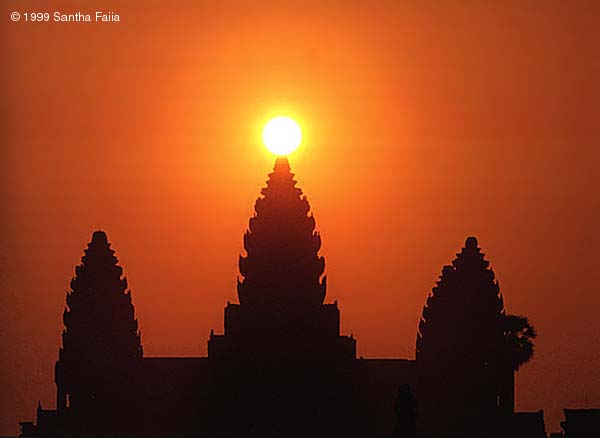
Angkor Vat is the biggest temple in the world (162 hectares and more than a thousand buildings). It was built following the canon and methodology of Vaastu Shastra. The transcendentally beautiful positioning of the Sun during the equinoxes shows the astrogeomantic principle of alignment, simultaneously astronomical and spiritual (Imagen:©1999 Santha Faiia. wwwhttps://grahamhancock.com).


Feng Shui and Chi

Feng shui (wind water) considers the omnipresence of Chi – a subtle energy that affects human beings and is susceptible of modification – as a starting point for the analysis and subsequent prescription of a geographic place or habitable space, with the purpose to harmonize and optimize its use. The principles of feng shui have been utilised during millennia to locate, design and build all the capital cities of China, its temples, sacred enclosures, palaces, tombs, community spaces, agricultural plots, roads. Its origins are fused with those of Taoism, 4,000 years ago at the very least.

The concept of Chi is not easily explainable to the modern mind dominated by the left cerebral hemisphere and spiritually buried under the paradigm of scientific materialism, from which it is encouraged to distrust its intuition. Chi is mostly spoken of as a force or energy, although the original methodology of feng shui seems to be describing something more akin to a morphic resonance field, when it tells us that in order to harmonize and balance Chi, the strategy to follow is eminently astronomical, topographic and geometric, which it is then rounded off by an interpretation based on cosmological and mumerical archetypes.


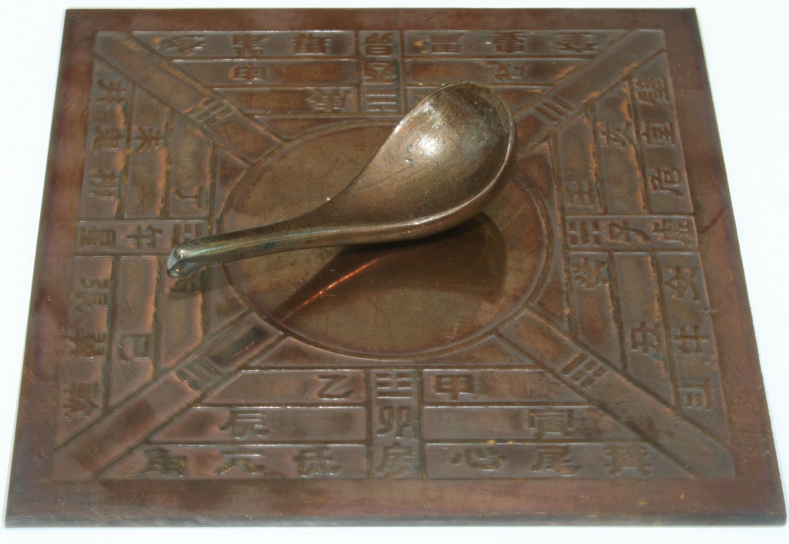
(Above) Someone in China, 2.300 years ago, forged a spoon out of magnetite and thus was born the magnetic compass, which was exclusively used for Feng Shui until the XI century. (Below) A later example of a geomantic Feng Shui compass with seven concentric rings that contain a profusion of spatial-temporal information, as well as directional, astronomical, astrological and philosophical formulae. (Images: https://en.wikipedia.org/wiki/History_of_the_compass)


Feng shui seeks an alignment with the cycles of the Sun, Moon, planets, the circumpolar stars and other constellations and, within certain modalities (such as the flying stars school), astrology is also combined. This celestial and temporal dimension is conjoined to the earthly and spatial plane by careful evaluation of the surrounding landscape, taking into account the shapes, contours and geological elements of the place; the topographic features are interpreted metaphorically in terms of different directional qualities of Chi; the azure dragon, the white tiger, etc. Both the terrestrial and astronomical factors possess complex numerological and archetypal inter-relations, which are schematically depicted in cosmograms; numerico-geometric representations of the cosmos that bear witness to the extreme antiquity of feng shui. 


Two versions of the Luo Shu “River Map”cosmogram. Beneath its apparent simplicity lie many layers of meaning in geometric and numerological key.


Conclusion

Both in vaastu shastra and feng shui, we can see fragments of that mode of unified perception so characteristic of the high cultures of antiquity who built astonishing megalithic monuments to harmonise, spiritualise and beautify the landscape. A worldview close to animism in its capacity to hear the silent voice of the Earth and resonate with its invisible vital forces, whilst at the same time partaking of the most exact scientific methodology in order to track astronomical patterns, compute calendrical cycles and construct huge, precise geometries across the planet. Astrogeomancy is therefore, concerned with harmonising not only inhabited spaces, but our collective home - the Earth – and the microcosmic spark within the human soul. Without doubt, its study can help us recover the great matrix of forgotten wisdom that allows us to understand empirically a more poetic and esoteric definition of Astrogeomancy; the ancient spiritual art and science of alignment between Heaven and Earth.


Appplied Astrogeomancy Courses

Starseeders Encounter, Ecuador. June 2024